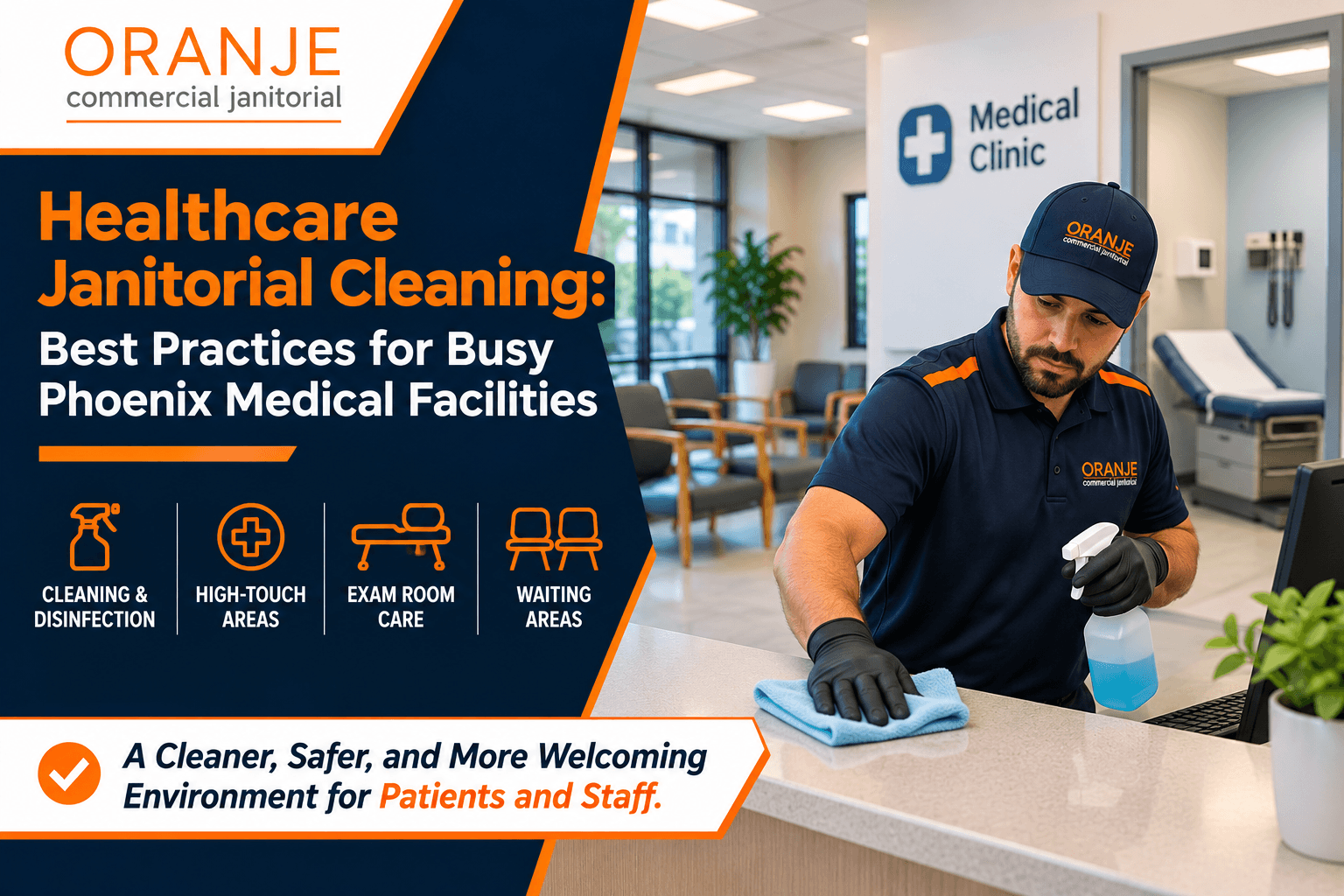
Healthcare cleaning is not the same as cleaning a standard office.
A medical facility may have waiting rooms, exam spaces, reception counters, staff areas, restrooms, treatment rooms, and shared corridors all operating at different levels of traffic throughout the day. Some areas need routine cleaning. Others need more careful disinfection. And certain clinical tasks, such as sterilizing instruments, belong with trained medical staff rather than the janitorial team.
For Phoenix clinics and medical offices, the challenge is keeping the facility clean without getting in the way of patients, staff, appointments, or treatment.
That requires more than a generic checklist.
It requires clear routines, the right products, careful timing, and good communication between the cleaning team and the people running the facility.
Why Healthcare Cleaning Needs More Structure
A medical office may look clean at first glance and still have problem areas.
Reception counters get touched constantly. Waiting room chairs see steady turnover. Restrooms may need attention several times a day. Exam spaces can move from one patient to the next with very little downtime.
That is why cleaning frequency should follow use, not just square footage.
A small clinic with a full appointment book may need more attention than a larger office with lower daily traffic.
For healthcare facilities that need a broader service plan, Oranje’s cleaning support for active medical environments covers the commercial service side in more detail.
This article focuses on the daily operational side.
Understand the Difference Between Cleaning and Disinfection
This is one of the most important distinctions in a medical environment.
Cleaning removes visible soil, dust, residue, and organic material from a surface.
Disinfection is a separate step that uses an appropriate product to reduce microorganisms on environmental surfaces.
Sterilization is different again. In most medical facilities, sterilization of instruments and clinical equipment is handled by clinical staff using dedicated procedures and equipment.
A janitorial team should not blur those responsibilities.
That separation matters because healthcare cleaning needs clear boundaries. Cleaning staff should know which areas they maintain, which products they use, and which items they should never handle.
Competitor healthcare providers commonly make this same distinction between environmental cleaning, disinfection, and clinical sterilization.
High-Touch Areas Need More Frequent Attention
Not every surface in a medical office needs the same frequency.
High-touch areas often include:
- Reception counters
- Door handles
- Waiting room chair arms
- Light switches
- Restroom fixtures
- Exam room surfaces
- Shared staff-area touchpoints
- Elevator buttons
- Handrails
These surfaces may need attention more often than walls, low-use shelving, or administrative areas.
The right frequency depends on traffic, patient flow, and how the space is used.
Stratus also emphasizes waiting areas, reception desks, restrooms, exam rooms, and other frequently touched surfaces as priority zones in medical-office cleaning.
Exam Rooms Need Clear Cleaning Boundaries
Exam rooms are one of the places where the cleaning scope needs to be especially clear.
The janitorial team may be responsible for:
- Floors
- Environmental surfaces
- Trash removal to designated collection areas
- Sink and counter cleaning
- Touchpoint disinfection
- General room reset
But clinical supplies, instruments, sharps containers, medication areas, and medical equipment should follow the facility’s own procedures.
Cleaning crews should not guess.
If a surface or item falls outside the agreed janitorial scope, the safest approach is to leave it for the clinical team and report the issue if needed.
That kind of role clarity is just as important as the cleaning itself.
Product Use and Contact Time Matter
Using the right disinfectant is only part of the job.
The product also needs to be used correctly.
That means following label directions, using the correct dilution where applicable, and allowing the surface to remain wet for the required contact time.
Wiping a disinfectant off too quickly can reduce its effectiveness.
This is why healthcare cleaning teams should be trained on the actual products being used in the facility, rather than simply being told to “disinfect everything.”
Product choice should also fit the surface.
A chemical that works well on one material may damage another.
For facility managers reviewing the safety side of chemical handling, Oranje’s article on workplace cleaning and safety expectations provides useful context around labeling, storage, and safe product use.
Waiting Rooms Need Both Appearance and Hygiene
Waiting rooms are different from exam rooms.
They are public-facing, heavily used, and often the first place patients form an impression of the facility.
Cleaning priorities usually include:
- Floors
- Chairs
- Side tables
- Reception counters
- Door glass
- Touchpoints
- Interior trash bins
- Restrooms nearby
Dust and visible debris can make the space feel poorly maintained even when clinical areas are handled correctly.
Phoenix adds another challenge: outdoor dust can move through entrances quickly, especially in busy ground-floor clinics.
That is why entrance maintenance and floor care often need to be part of the same routine.
Floors Need a Separate Maintenance Plan
Medical facilities often use several flooring types in one building.
You may have resilient flooring in corridors, tile in restrooms, carpet in offices, and specialty surfaces in treatment areas.
Each one needs different care.
Daily maintenance may include vacuuming, dust mopping, wet mopping, and spot response.
Periodic care may involve machine scrubbing, burnishing, carpet extraction, or grout maintenance.
For heavily used medical corridors, scheduled care for clinical and common-area floors can help address buildup that daily mopping cannot fully remove.
Floors also need to be cleaned at times that reduce disruption and slip risk.
That usually means coordinating work around appointments, shift changes, or after-hours access.
Daytime Cleaning Can Help Busy Clinics
Some healthcare facilities cannot rely on evening cleaning alone.
A restroom issue at noon cannot wait until 7 p.m.
The same applies to spills, waiting-room debris, supply restocking, or unexpected messes during a busy clinic day.
That is where daytime support for patient-facing areas can be useful.
The goal is not to perform deep cleaning while patients are moving through the facility.
It is to handle the small issues that affect the space between scheduled services.
This can include:
- Restroom checks
- Entryway upkeep
- Spill response
- Touchpoint wiping
- Common-area cleanup
- Supply monitoring
Prevent Cross-Contamination Between Areas
Cleaning tools should not move carelessly from one area to another.
A cloth used in a restroom should not then be used at a reception desk.
Mops, cloths, and other tools should follow a controlled system based on the facility’s cleaning procedures.
Some facilities use color-coding or area-specific tools to reduce the chance of cross-contamination.
The exact system may vary, but the principle stays the same: equipment used in higher-risk or dirtier areas should not move freely into cleaner spaces.
That is one reason healthcare cleaning needs more structure than a standard office routine.
Timing Matters as Much as Technique
Healthcare facilities run on schedules.
Cleaning crews need to understand when certain rooms are available, when patient traffic is highest, and when quiet work is expected.
A good schedule may include:
- Light upkeep during operating hours
- Restroom and waiting-room checks during the day
- Exam-room cleaning during approved windows
- Floor work after patient hours
- Deeper cleaning during low-traffic periods
The same operational principle appears in other complex facilities. Oranje’s article on cleaning around active production schedules shows why timing and coordination often matter as much as the cleaning method itself.
Quality Checks Should Be Part of the Routine
A healthcare cleaning program should not rely only on whether the room “looks fine.”
Routine inspections help identify patterns.
A simple review may check:
- Floor condition
- Restroom condition
- Touchpoint completion
- Supply levels
- Missed surfaces
- Recurring issues
- Response to reported concerns
Some healthcare-cleaning providers use formal scoring systems and documented inspections to keep performance consistent.
For property and facility managers, Oranje’s article on tracking cleaning performance with clearer standards explains how inspections and documentation can improve vendor accountability.
Coordinate Carpet and Soft-Surface Care Separately
Not every healthcare space is hard flooring.
Administrative offices, consultation rooms, reception areas, and some waiting rooms may include carpet.
Routine vacuuming is necessary, but it does not replace periodic extraction.
For facilities with carpeted administrative or patient-facing areas, periodic carpet extraction for busy interiors can be planned around operating hours and drying time.
Oranje’s article on choosing between truck-mounted and portable extraction can also help facility managers understand which method may make more sense based on access and layout.
Healthcare Cleaning Should Support the Facility, Not Interrupt It
The best cleaning plan works around the medical operation.
That means understanding:
- Patient volume
- Appointment schedules
- Room turnover
- Staff workflows
- Restricted areas
- High-touch zones
- Product requirements
- After-hours access
- Areas that need more frequent checks
Phoenix healthcare facilities also need to account for dust, entrance traffic, and seasonal changes in building use.
The service plan should adapt when the facility changes.
A clinic that adds evening appointments may need a different schedule. A medical office that expands patient volume may need more daytime checks. A new flooring type may need a different maintenance process.
Cleaning should evolve with the operation.
Final Thoughts
Healthcare janitorial work is not about making a medical office look polished.
It is about maintaining a controlled, orderly environment that supports patients, staff, and daily operations.
That means understanding the difference between cleaning and disinfection, keeping high-touch surfaces on a sensible schedule, using products correctly, protecting against cross-contamination, and knowing where the janitorial role ends and the clinical role begins.
Oranje’s commercial cleaning teams work with Phoenix medical offices and clinics around patient schedules, shared spaces, floor care, restrooms, common areas, and environmental surface cleaning.
The goal is not to interfere with care.
It is to keep the facility consistently maintained so the people providing that care can focus on their work.

Joshua Woodworth is the CEO of Oranje Commercial Janitorial in Phoenix, AZ, bringing over 15 years of experience in facilities management with a focus on large custodial operations in government, Class-A, multi-tenant, multi-site, and K-12/higher education settings. A graduate of the University of Wisconsin-Platteville, he has overseen multi-million-dollar accounts and managed sites exceeding 10 million square feet, including athletic, academic, administrative, research, and residential facilities. Known for his expertise in custodial transitions and relationship management, he places a strong emphasis on developing long-term partnerships, which is reflected in his daily approach to work. Outside of work, Joshua enjoys volunteering in youth sports, traveling with his family, and exploring new ways to elevate the cleaning industry.