Commercial carpet usually doesn’t fail overnight.
It happens gradually. Entry lanes darken, office traffic paths start looking dull, and spots seem to return even after routine cleaning. Daily vacuuming helps, but eventually the carpet needs deeper extraction.
That is when facility managers usually hear two options: truck-mounted carpet cleaning and portable extraction.
Both are professional methods. Both can work well. The better choice depends on the building, access, carpet condition, and how quickly the space needs to return to service.
For Phoenix commercial properties, there is another factor: fine dust and grit that gets tracked indoors throughout the year.
What Is the Difference?
Both truck-mounted and portable systems can use hot-water extraction to loosen soil and recover dirty water from the carpet.
The main difference is where the equipment operates.
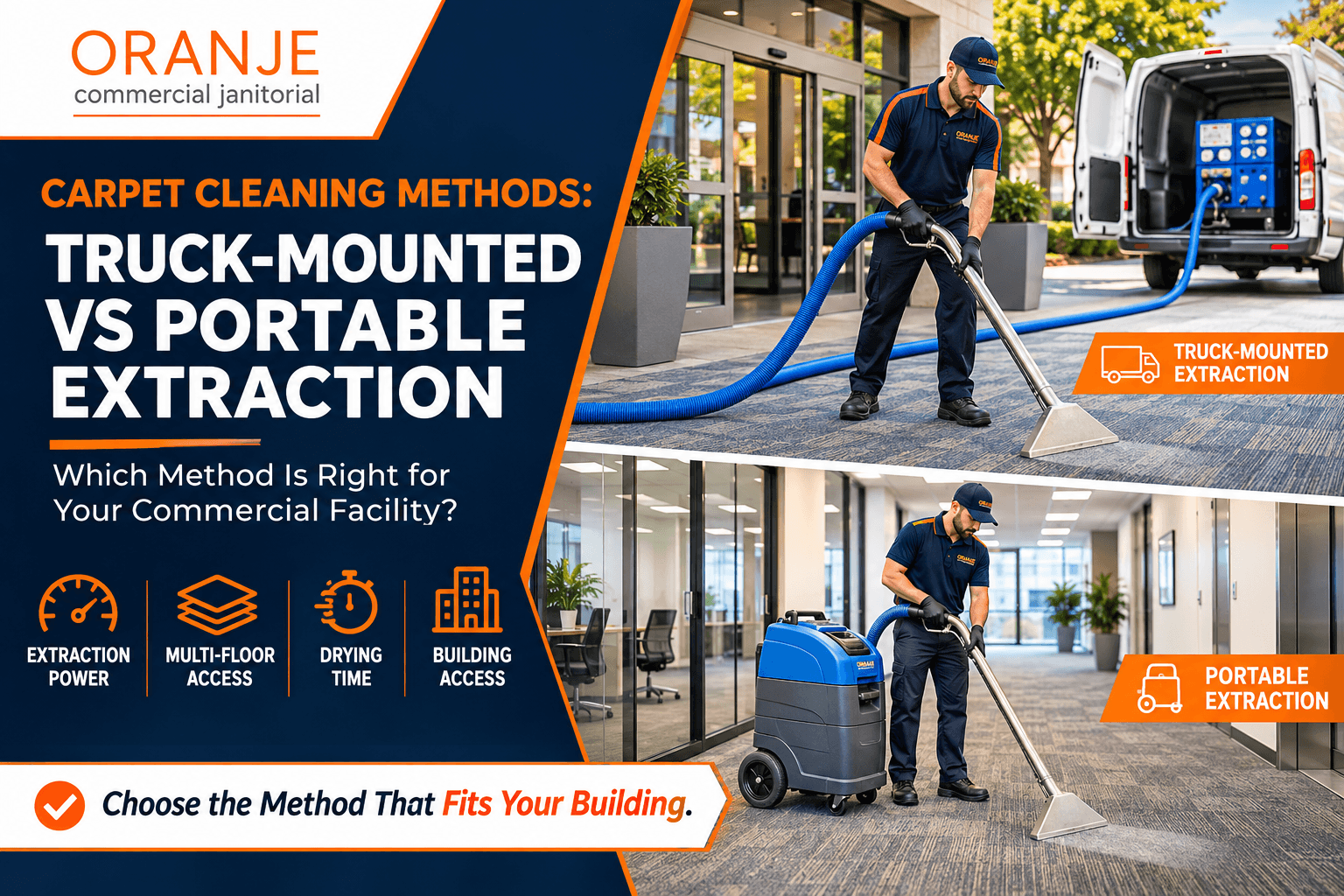
A truck-mounted system stays inside the service vehicle. Long hoses run from the truck into the property. Because the main machine remains outside, these systems can usually provide stronger heat and vacuum recovery.
A portable extractor is rolled directly into the building. It carries its own clean-water and recovery tanks and can be moved between rooms, suites, or floors.
The choice should not be based only on machine size.
It should be based on what the property actually needs.
When Truck-Mounted Cleaning Makes Sense
Truck-mounted extraction is especially useful when a property has large carpeted areas and convenient ground-level access.
Examples may include:
- Office buildings
- Hotel common areas
- Clubhouses
- Large lobbies
- Commercial common areas
- Ground-floor tenant spaces
The stronger vacuum recovery can help remove more moisture after cleaning, which may support faster drying.
For properties scheduling deeper extraction for heavily used carpet, this can be useful when a lot of space needs to be completed during a limited after-hours window.
Truck-mounted systems can also reduce the amount of equipment being moved through the facility because most of the machinery stays outside.
When Portable Extraction Is the Better Option
Not every building is designed for truck-mounted equipment.
A high-rise office, interior tenant suite, or property with limited parking access may make long hose runs impractical.
That is where portable extraction becomes valuable.
Commercial portable machines can be moved through elevators and positioned close to the area being cleaned. For many multi-level buildings, that is not a compromise. It is the more practical method.
Professional portable equipment is also very different from consumer rental machines.
It is designed for repeated commercial use and can handle offices, schools, hospitality spaces, common areas, and similar environments when used correctly.
Truck-Mounted vs Portable: Quick Comparison
| Consideration | Truck-Mounted | Portable |
|---|---|---|
| Extraction power | Usually stronger | Good commercial performance |
| Heat capability | Typically higher | Varies by machine |
| Large open areas | Very efficient | May require more setup |
| Upper floors | More difficult | Well suited |
| Vehicle access | Required | Not required |
| Interior suites | Depends on hose reach | Easy to access |
| Drying potential | Often faster | Depends on technique |
| Best use | Large accessible areas | Multi-floor or restricted areas |
In many cases, the building layout makes the decision.
Cleaning Power Is Only Part of the Process
A powerful machine cannot make up for poor technique.
Good commercial carpet care usually starts with dry soil removal. Spots need to be identified, traffic lanes may need pre-treatment, and the technician should understand the carpet type before extraction begins.
Too much solution, poor recovery passes, or over-wetting can still cause problems.
That is why carpet cleaning should involve more than simply running equipment across the floor.
Daily cleaning also matters. Routine cleaning across the rest of the facility helps reduce the amount of dust and debris that eventually works its way into carpet fibers.
Phoenix Dust Changes Carpet Maintenance
Phoenix properties deal with constant outdoor dust.
It enters through doors, parking areas, loading zones, carts, and employee foot traffic. Some of that dry soil works its way below the visible surface of the carpet.
Over time, this is what often causes dark traffic lanes and worn-looking entrance areas.
Regular vacuuming helps control loose soil, while extraction removes buildup that routine maintenance does not fully address.
Facilities already adjusting maintenance around Phoenix’s seasonal cleaning conditions should use the same approach with carpet. A fixed once-a-year schedule may be enough for one building but not for another.
What About Bonnet Cleaning?
Not every carpet maintenance visit needs full extraction.
Bonnet cleaning can be useful as an interim method. It works mainly on the surface and can help improve the appearance of traffic lanes between deeper cleaning services.
A practical commercial carpet program may include:
- Regular vacuuming
- Spot treatment
- Interim bonnet cleaning
- Periodic extraction
Each method serves a different purpose.
The goal is to avoid waiting until the carpet looks heavily soiled before taking action.
Drying Time Matters in Commercial Buildings
For businesses, cleaning is only part of the job.
The carpet also needs to be ready when employees, tenants, or customers return.
Truck-mounted systems often have an advantage because stronger vacuum recovery may remove more moisture during extraction.
But drying time still depends on:
- Carpet type
- Amount of solution used
- Airflow
- Indoor temperature
- Soil level
- Number of recovery passes
- Furniture placement
Good scheduling matters as much as equipment.
Oranje notes that drying time can vary depending on the method and carpet type, and that after-hours cleaning often works best for commercial facilities.
For busy buildings, on-site support between scheduled deep cleans can also help keep entrances and common areas presentable between carpet services.
Review the Building Before Choosing the Method
Before deciding on truck-mounted or portable extraction, the cleaning team should review the property.
Important questions include:
- How close can the vehicle get to the entrance?
- Is the carpet on an upper floor?
- Can hoses be routed safely?
- Are elevators available?
- How much carpet is being cleaned?
- When does the space need to reopen?
- Are there sensitive areas nearby?
- Will furniture need to be moved?
Property managers who already use measurable standards for cleaning vendors should use the same approach for carpet work.
The scope should define the area, method, schedule, and access requirements before cleaning starts.
Coordinate Carpet With Other Floor Care
Commercial properties often use multiple flooring types.
A lobby may start with tile and transition into carpet. Dirt moves between both surfaces.
Cleaning the carpet while ignoring the adjacent hard floor can shorten the time before the carpet starts looking dirty again.
That is why carpet work often makes sense alongside maintenance for adjoining hard-surface floors.
Exterior conditions matter too. Dusty entryways and loading areas can continuously feed dirt back into the building. Periodic exterior cleaning around entrances and traffic routes can help reduce some of that buildup.
How Often Should Commercial Carpet Be Cleaned?
There is no single schedule that works for every property.
High-traffic areas may need deeper cleaning more often than private offices or low-use rooms.
A practical approach is to divide carpet by traffic level.
High Traffic
Entrances, reception areas, elevator lobbies, main corridors, and waiting areas.
Moderate Traffic
Shared offices, conference rooms, and secondary hallways.
Low Traffic
Private offices and limited-access rooms.
Facility managers should watch how the carpet performs between cleanings.
If traffic lanes are already dark months before the next scheduled service, the cleaning frequency likely needs to change.
The same logic applies when reviewing the cost of commercial cleaning in Phoenix. Carpet extraction is usually a periodic service, not a replacement for routine janitorial work.
What Should You Ask a Carpet Cleaning Company?
Instead of asking only whether they use a truck-mounted system, ask:
- Which method would you use in this building?
- Why is that method appropriate here?
- How much drying time should we expect?
- How will upper floors be handled?
- How are traffic lanes treated?
- What needs to be moved?
- How will hoses and equipment be managed?
The method should follow the property assessment.
That same principle applies when evaluating a commercial cleaning contractor. Equipment matters, but so do scheduling, communication, training, and experience working around active facilities.
Final Thoughts
Truck-mounted carpet cleaning usually offers stronger heat, suction, and water recovery. For large, accessible commercial areas, it can be an efficient choice.
Portable extraction solves a different problem.
It allows professional carpet cleaning in upper floors, interior suites, and buildings where a truck-mounted system is difficult to use.
So the better question is not, “Which machine is better?”
It is, “Which method fits this building?”
Oranje uses both truck-mounted and portable extraction depending on the property, carpet condition, access, and operating schedule.
That is the practical way to approach commercial carpet cleaning in Phoenix: choose the method around the building, not the machine.

Joshua Woodworth is the CEO of Oranje Commercial Janitorial in Phoenix, AZ, bringing over 15 years of experience in facilities management with a focus on large custodial operations in government, Class-A, multi-tenant, multi-site, and K-12/higher education settings. A graduate of the University of Wisconsin-Platteville, he has overseen multi-million-dollar accounts and managed sites exceeding 10 million square feet, including athletic, academic, administrative, research, and residential facilities. Known for his expertise in custodial transitions and relationship management, he places a strong emphasis on developing long-term partnerships, which is reflected in his daily approach to work. Outside of work, Joshua enjoys volunteering in youth sports, traveling with his family, and exploring new ways to elevate the cleaning industry.